Nobody Clicks the Citations: 11,048 Sessions of a Deployed AI Tutor
We added citations to YouWoAI so students could verify answers. In a course pilot, 71% engaged with them. In production: 1.6%. What actually drives verification isn't more citations — it's conversational context.
At YouWoAI we built what the RAG literature says you should build: every answer comes with inline citation markers, citation cards, and an in-app evidence viewer that shows the exact source passage. The premise is that citations lower the cost of verification, so students will verify instead of blindly trusting the model.
Then we instrumented everything and looked at whether anyone actually does.
This is an ongoing study (with Jack Sun and Michael Jongho Moon at the University of Toronto) comparing two data sources from the same system: a course-context pilot with consenting students (55 tasks, run under a UofT research ethics protocol) and two months of anonymized production telemetry from a research cohort of 202 users who opted into the study — drawn from YouWoAI's 20,000+ user platform — totaling 11,048 sessions and 629 citation clicks. The headline numbers changed how I think about "trustworthy AI" features.
The ecological-validity gap
In the course pilot, students clicked citations in 70.9% of tasks, and 82% of clicks progressed to actually opening the evidence panel.
In production — same product, same citations, no instructor watching:
- 1.58% of citation-bearing sessions had any citation click (Cohen's h = 1.75 vs. the pilot; risk ratio ≈ 45).
- 82.2% of the cohort never clicked a citation once, across all their sessions over two months.
- Among users who eventually clicked, the median time-to-first-click was 9 sessions. Verification isn't a first-encounter behavior; it's a slowly acquired habit.
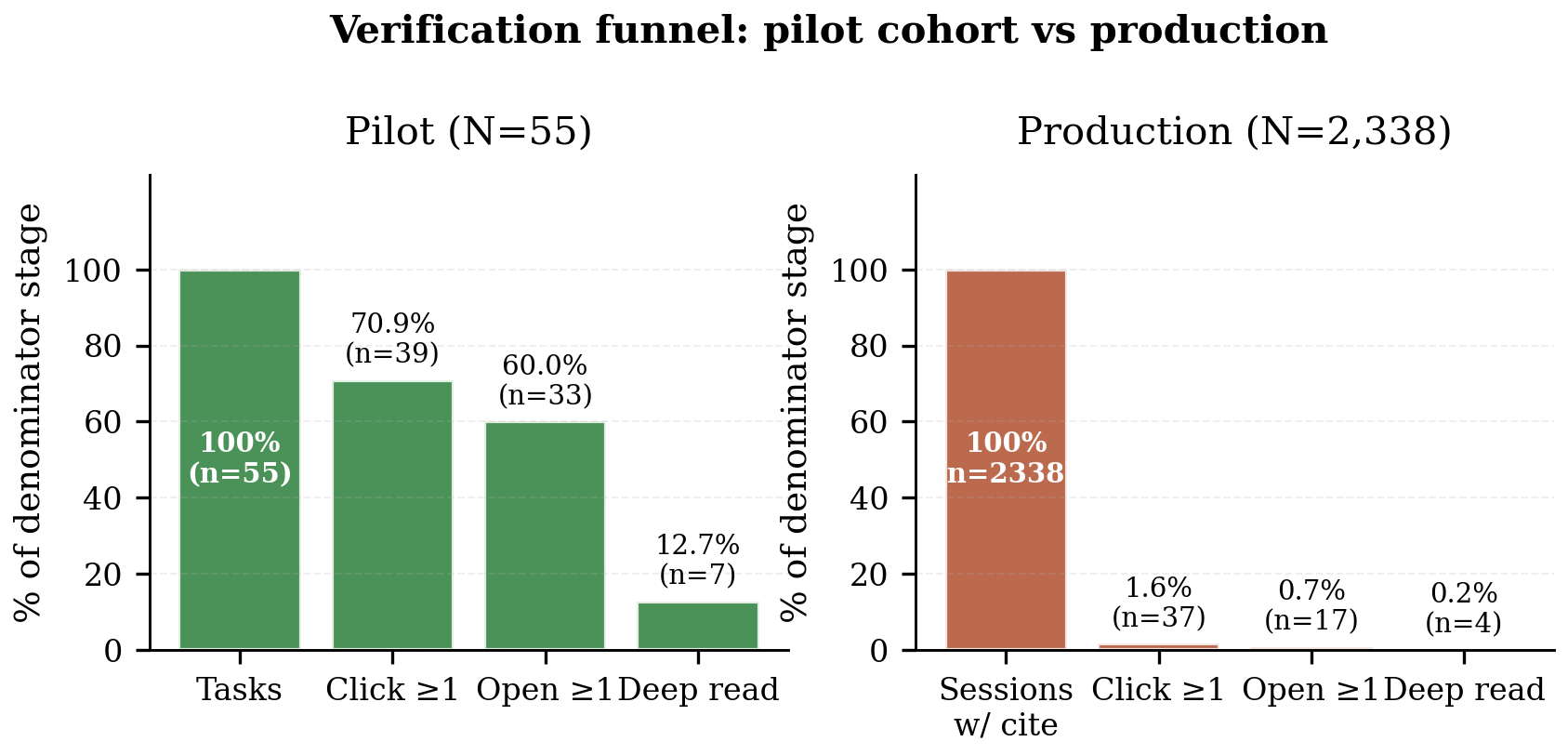
If you've only evaluated your verification UX in a classroom study or a user test, you've probably measured the incentive structure of the study, not your design. Every controlled result deserves a deployment replication before you believe it.
Context is the lever — a 49× one
The production data has three conversational contexts: note (chat grounded in a single document), folder (multi-document RAG), and open chat (no document grounding). Source-opens per session:
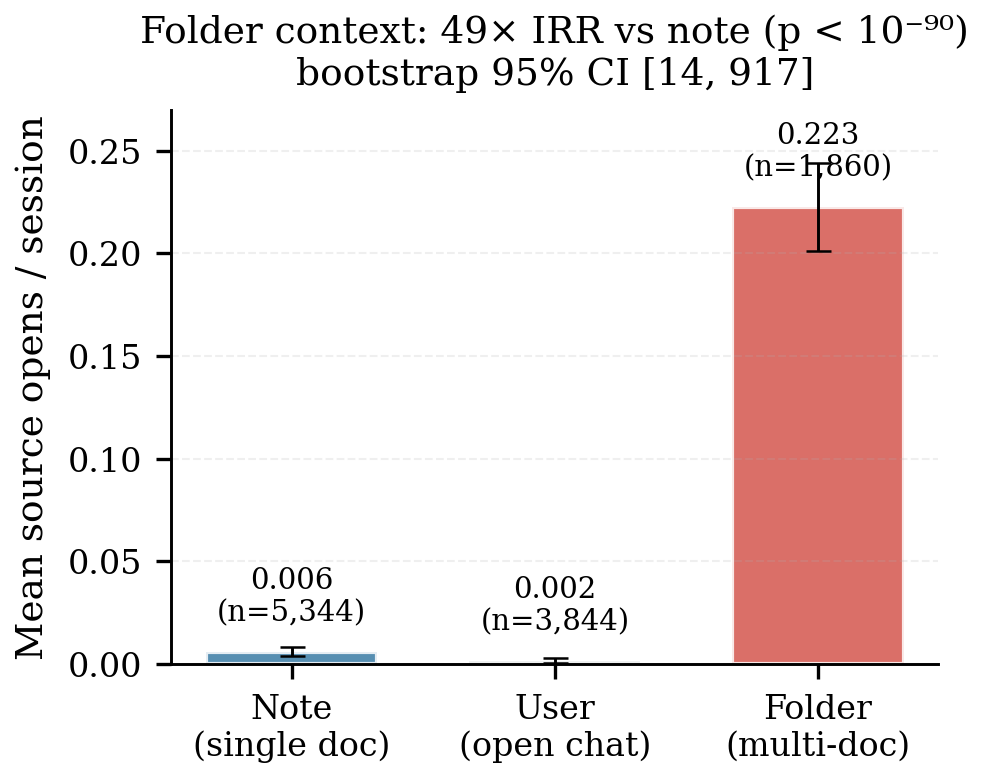
Folder sessions are also longer and chattier, so we fit a negative-binomial model controlling for session duration, message count, and platform. The effect survives, enormously: IRR = 49 for folder context vs. single-document (cluster-bootstrap 95% CI [14, 917], and the lower bound is still 14×). Meanwhile open chat suppresses verification relative to single-document context (IRR = 0.31) once you control for confounds.
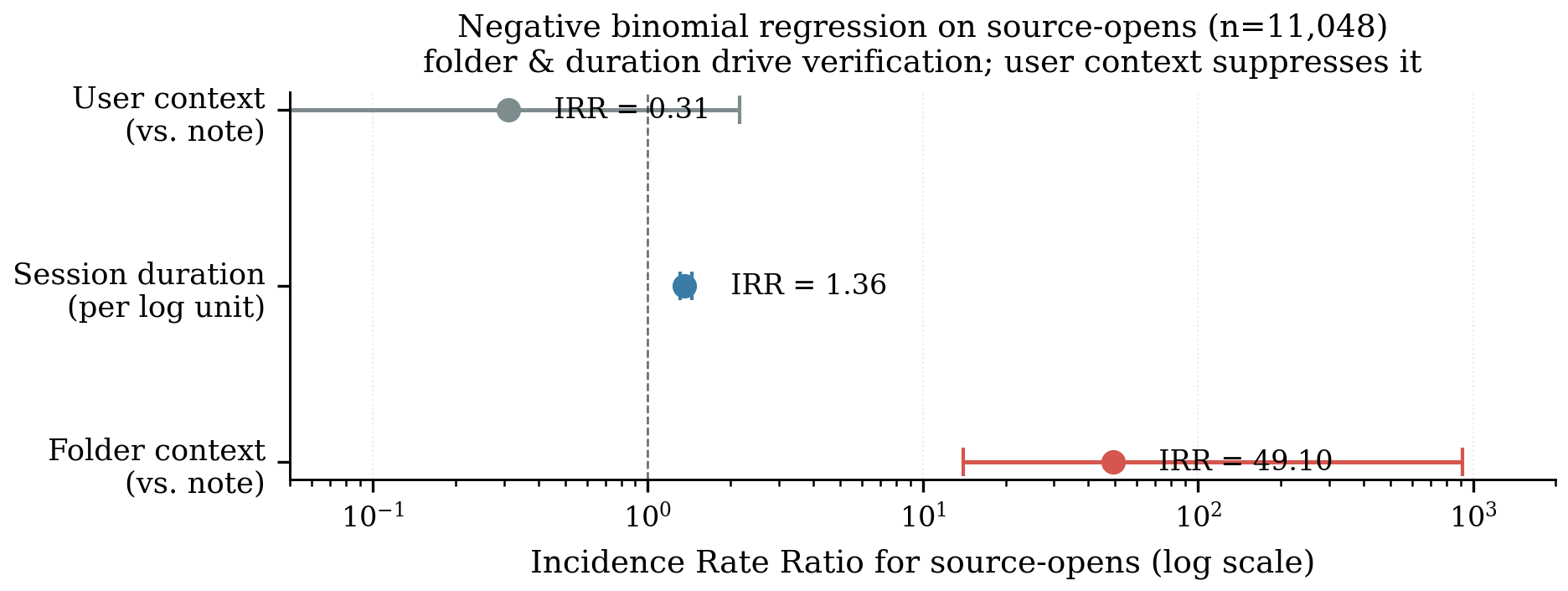
Information Foraging Theory gives a clean account: when an answer synthesizes multiple heterogeneous sources, disambiguating "which document said this" has real value, so users open sources. A single-document answer creates no such pressure. Open chat creates none at all.
Keep verification inside the app
Citations pointing at the user's own in-app notes progressed to a source-open at 3.46× the rate of citations pointing at external web links.
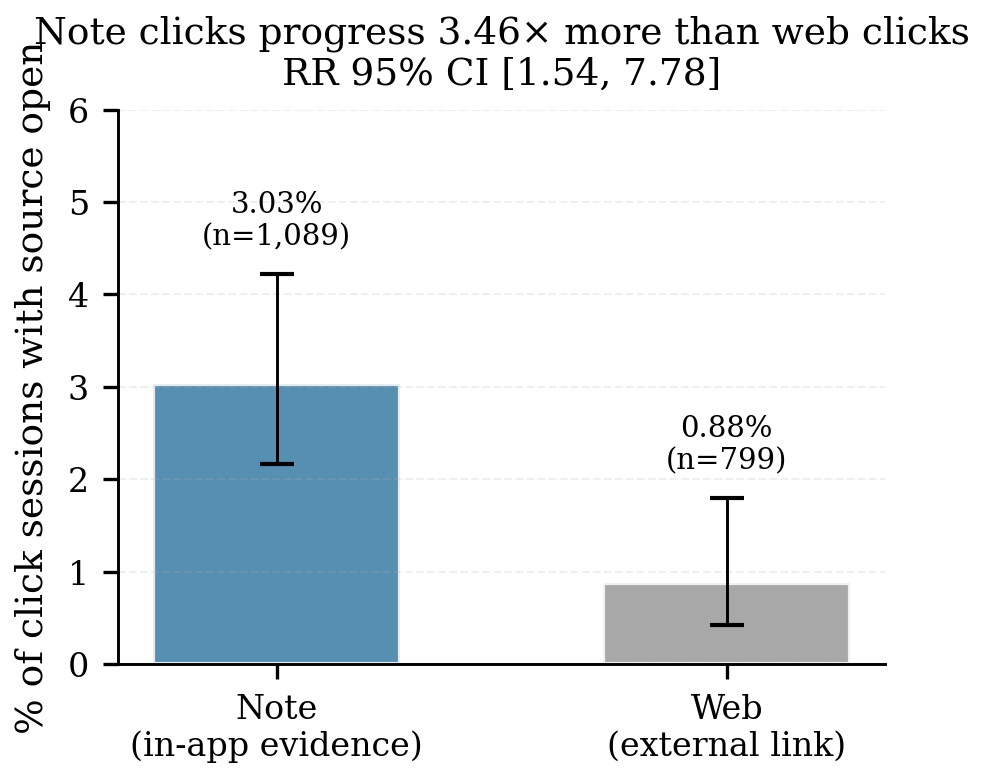
Part of this is mechanical — a web citation opens an external tab and leaves our instrumented surface — but the design implication holds either way: every external-link citation forfeits the verification interaction. If you can render the source in an in-app evidence panel, do it.
Three modes of "reading the evidence"
We originally proposed a four-level Verification Depth Score (click → open → scroll → deep read). The data disagreed. A Gaussian mixture over log dwell times in the evidence viewer finds exactly three modes:
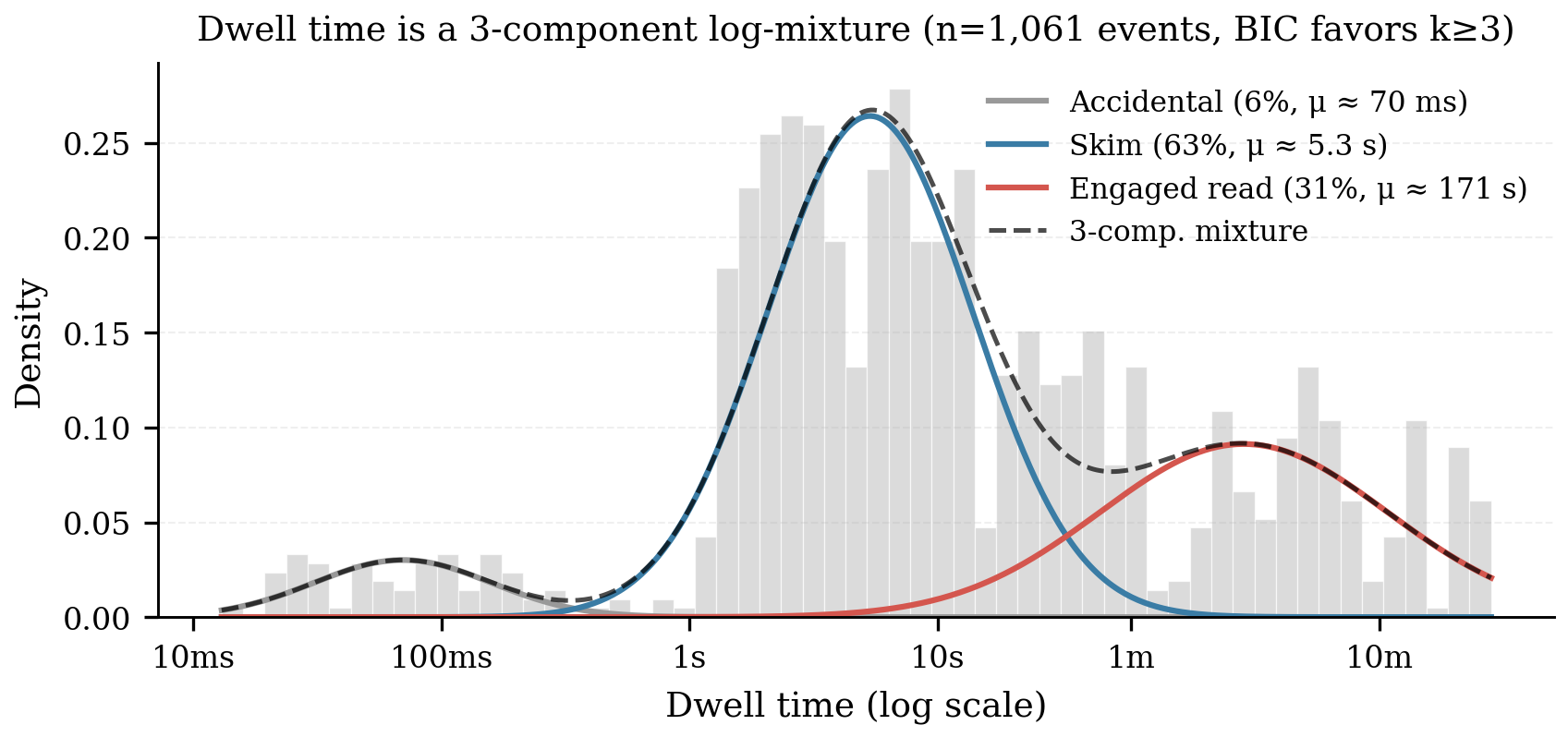
- Accidental (~6%): μ ≈ 70 milliseconds. A misclick, not a behavior.
- Skim (~63%): μ ≈ 5.3 s. A glance to confirm the source exists.
- Engaged read (~31%): μ ≈ 171 s. Actual verification.
A mixed-effects model puts the between-user share of dwell variance at ICC = 0.20 — being a "verifier" is partly a stable trait, but mostly situational. Which is good news: situations are designable.
The null result that matters most
Showing more citations does nothing. A logistic regression of any-click on citations-per-message — controlling for duration, context, platform — finds no effect (OR = 1.09, p = 0.36).
I want to underline this because it's the cheapest mistake to make: citation quantity looks like diligence, demos well, and has zero behavioral effect. The levers that actually move verification, in our data, are conversational context and session time.
What I'd tell someone building grounded AI
- Don't equate citation availability with verification. Availability is table stakes; behavior needs a reason.
- Engineer the context, not the citation count. Multi-document grounding is the one condition where verification happens at scale. Make extending a chat to multiple documents trivial — or the default.
- Own the verification surface. External links leak engagement; in-app evidence viewers keep it.
- Re-run your classroom numbers in the wild before quoting them. Ours dropped 45×.
This is work in progress — the folder effect is correlational and needs a randomized test, iOS instrumentation had gaps, the telemetry covers the opted-in research cohort rather than the full user base, and we haven't linked engagement to learning outcomes yet. But the gap itself is too large to wait on: if your "trustworthy AI" story depends on users checking sources, deployment data probably disagrees with your user study.