Ranking Beats Accuracy: What We Learned Scheduling GPUs with ML
We revisited Shortest-Job-First scheduling on production GPU traces from Alibaba. SJF is much fairer than its reputation — and your runtime predictor doesn't need to be accurate, it needs to sort.
Shared GPU clusters have a queueing problem. Job runtimes span four orders of magnitude — a 30-second smoke test waits behind a week-long training run — so under contention, waiting time dominates how slow the cluster feels, not compute.
Shortest-Job-First (SJF) is the textbook answer: when runtimes are known, it's provably optimal for average completion time. But two objections have kept it out of favor. First, fairness — prioritizing short jobs supposedly starves long ones, which is why fairness-first schedulers like Themis and Quincy exist. Second, you don't know the runtimes — SJF needs a prediction, and predictions are wrong.
Yi Yang and I spent a term at the University of Toronto testing both objections against production-scale traces (~100,000 jobs from Alibaba's GPU clusters) with an extended cluster simulator. Both objections mostly don't survive contact with the data. This post is the tour; the full write-up is in our workshop paper (PDF).
Finding 1: SJF's fairness problem is smaller than its reputation
We compared FIFO against oracle SJF (true runtimes) and three history-based SJF variants that estimate runtime from per-user, per-group, and per-group-per-GPU-type averages (SJU / SJG / SJGG).
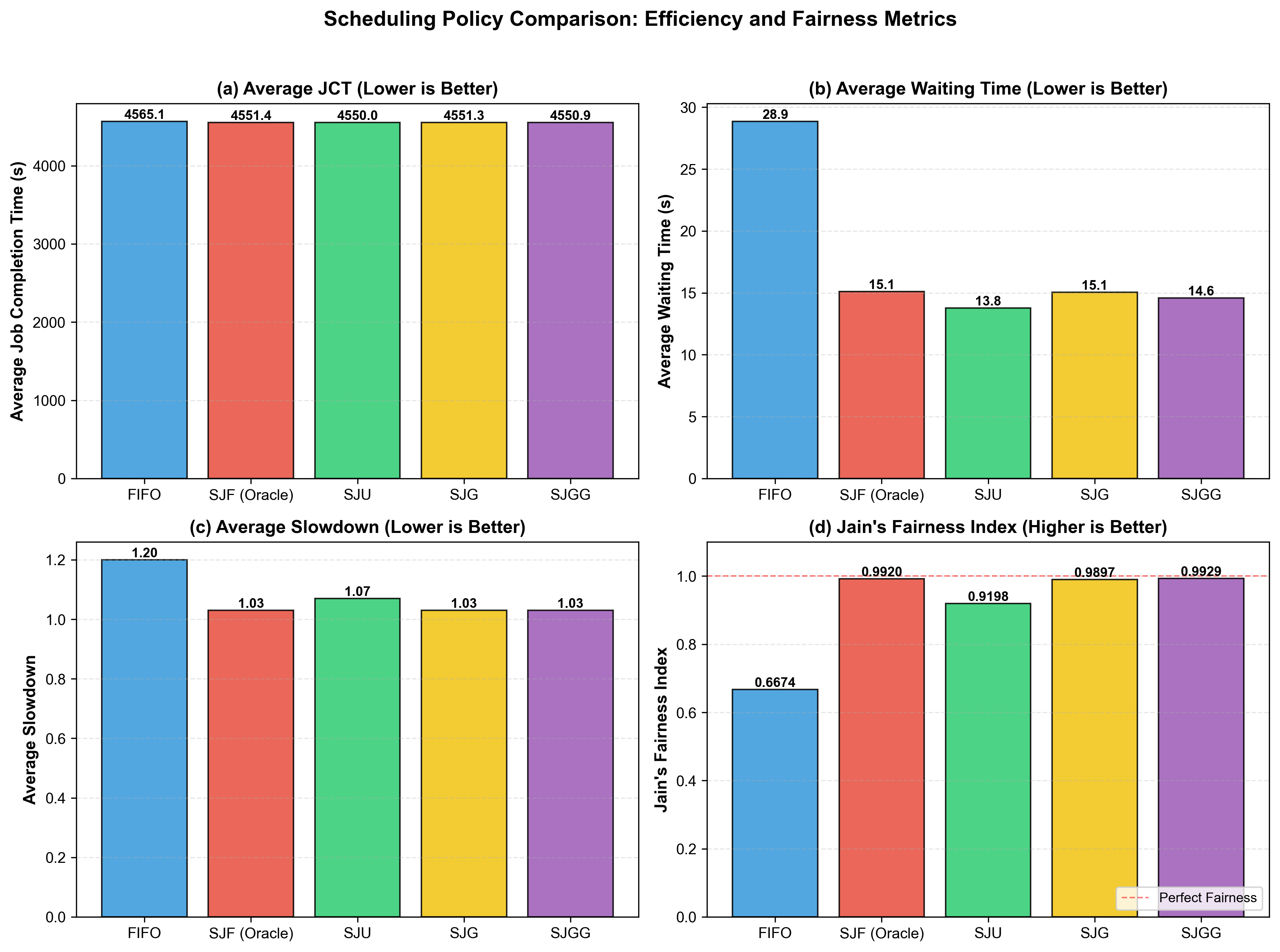
Three things stand out:
- Average JCT barely moves (under 1%). Long training jobs dominate the average, so no ordering policy can shift it much. If a scheduling paper leads with average JCT improvements, look closer.
- Waiting time is where SJF wins: 28.9s average under FIFO drops to ~14–15s under every SJF variant — roughly half — and average slowdown falls from 1.20 to 1.03.
- Fairness goes up, not down. FIFO's Jain's fairness index across users is 0.667; oracle SJF scores 0.992. FIFO is the policy that treats users unequally — whoever queues behind a monster job loses. And across all our runs, with a one-hour starvation threshold, SJF starved zero jobs.
We also tested aging (priority boosts for waiting jobs) as a starvation guard. It's worth having as a worst-case bound in bursty workloads, but it didn't improve fairness on realistic traces — it slightly hurt it. Aging is a robustness mechanism, not a fairness mechanism.
Finding 2: predict in log space, or your tails will hurt you
To replace the oracle, we trained four runtime predictors on the trace features: an MLP, XGBoost, LightGBM, and a mixture-of-experts variant (CRR++: k-means clusters → one LightGBM expert each → random-forest router).
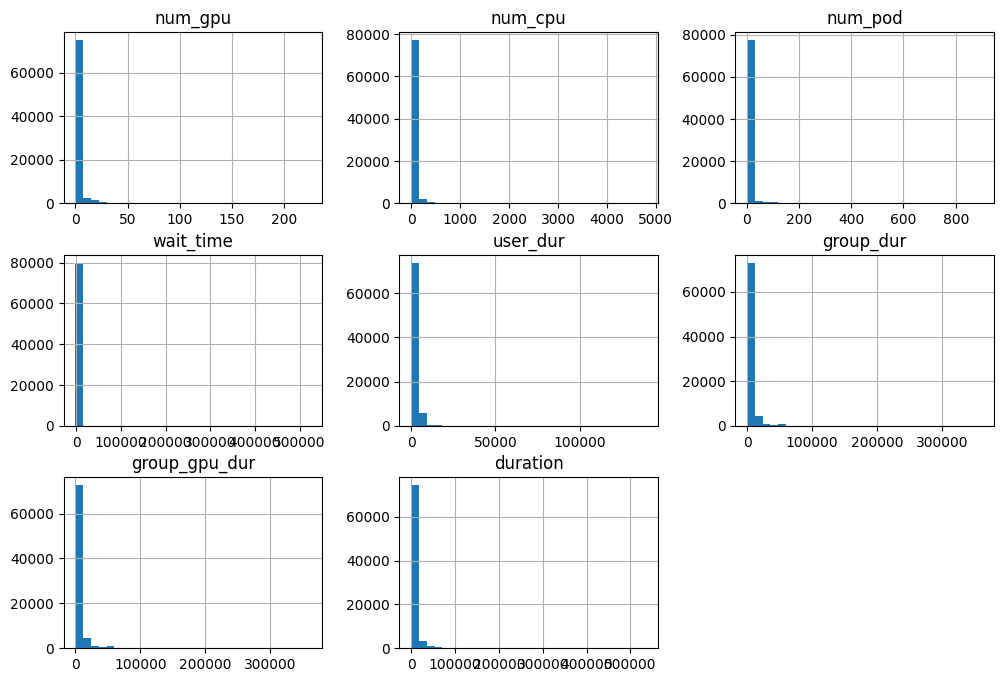
The trap is the target distribution. Raw GPU job durations are brutally right-skewed — most jobs are short, a few run five orders of magnitude longer:
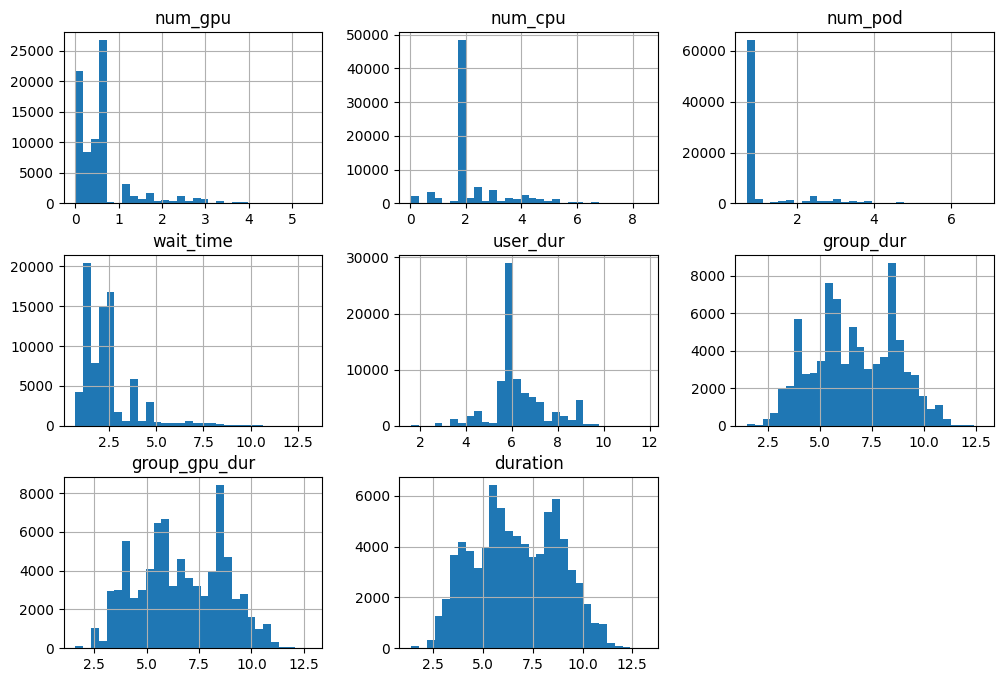
A log(x+1) transform makes the same features almost normal:
Prior work argued for MAE loss on raw durations because of the skew. We found the opposite works better: train with MSE on the log-transformed target. Same model, same features — here's XGBoost's signed percentage error both ways:
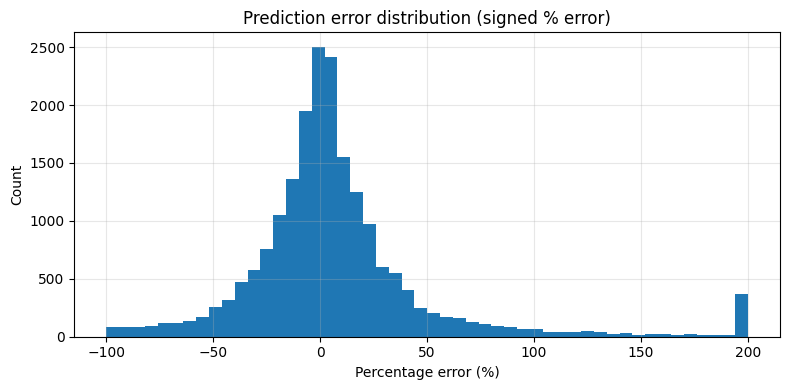
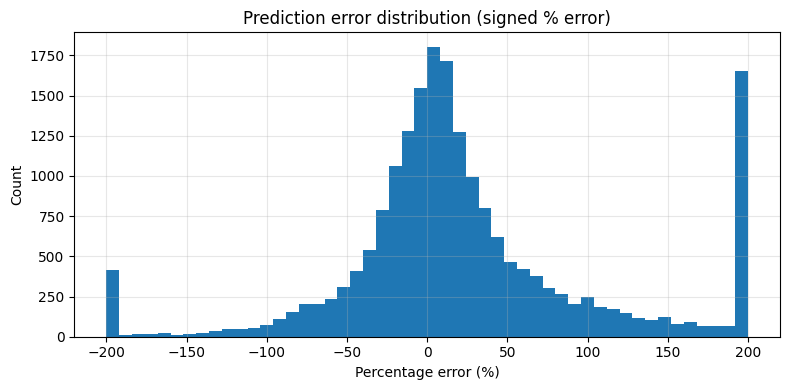
On the raw target, tree models fall apart in the tails — XGBoost's 95th percentile error jumps from 93% to 388%. The median barely changes (~15% either way); the tails are the whole story.
Finding 3: stop grading predictors on error — grade them on ordering
Here's the observation that reframed the project: SJF never uses the predicted runtime as a number. It only uses it to sort. A predictor that's 2× off on every job produces exactly the schedule of a perfect oracle, as long as the ordering holds.
So instead of RMSE, we evaluated rank alignment — Spearman's ρ (global monotonicity) and Kendall's τ (pairwise inversions, which is literally what corrupts an SJF queue):
| Predictor | Spearman's ρ | Kendall's τ |
|---|---|---|
| LightGBM (log+MSE) | 0.962 | 0.871 |
| XGBoost (log+MSE) | 0.961 | 0.871 |
| CRR++ (log+MSE) | 0.961 | 0.870 |
| MLP (log+MSE) | 0.956 | 0.862 |
gpu_group_dur heuristic | 0.94 | 0.84 |
group_dur heuristic | 0.88 | 0.77 |
user_dur heuristic | 0.32 | 0.23 |
Two takeaways. The learned models beat the best history-based heuristic, but not by miles — if you already bucket jobs by (group, GPU type), you've captured most of the ranking signal. And per-user averages alone (ρ = 0.32) are nearly useless: knowing who submitted a job tells you little about how long it runs.
When we plugged these predictors into the simulator (15,000 jobs, batched inference), ranking quality predicted scheduling performance better than any pointwise error metric did. Models with ~15% median error scheduled almost identically to the oracle.
Finding 4: the oracle isn't even optimal
The weirdest result: ML-assisted SJF occasionally beat oracle SJF on JCT, reproducibly.
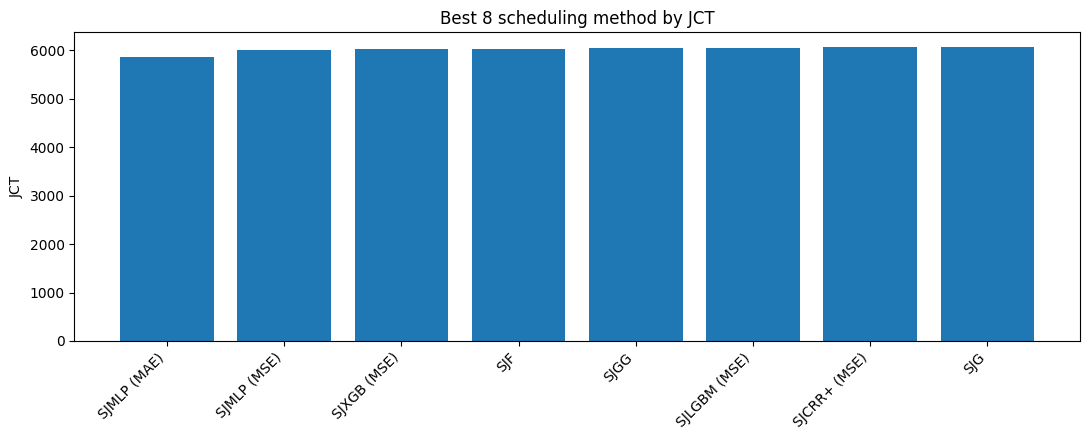
The explanation is placement coupling. The simulator (like real clusters) sorts a global queue, then greedily first-fits each job onto nodes. Ordering changes which nodes are free when each job is considered — so a "wrong" ordering can accidentally produce better packing, especially with multi-GPU jobs and GPU-type constraints causing fragmentation. Once scheduling and placement interact, perfect runtime knowledge no longer guarantees a perfect schedule. Ordering optimality ≠ end-to-end optimality.
An engineering footnote
Our first integration called the predictor every time the scheduler placed a task. Simulation time went from ~60s to 120–280s for the tree models and over 800s for the mixture-of-experts — almost entirely Python call overhead on tiny batches, not model compute. Batching all predictions before the scheduling loop brought inference under one second total. The model was never the bottleneck; the integration was. This generalizes.
What I'd tell someone building this
- Measure waiting time and tail slowdown, not average JCT. That's where scheduling policy actually shows up.
- SJF + a starvation bound is a strong default. Its unfairness is mostly folklore on realistic traces; FIFO is the unfair one.
- Train predictors on log-transformed targets, evaluate them with rank metrics. Kendall's τ against held-out runtimes is a better preview of scheduling performance than RMSE will ever be.
- Don't chase oracle accuracy. Ranking is the job. A grouped-history heuristic gets you 90% of the way; a LightGBM closes most of the rest.
Full details, metric definitions, and references are in the paper (PDF). Joint work with Yi Yang at the University of Toronto.